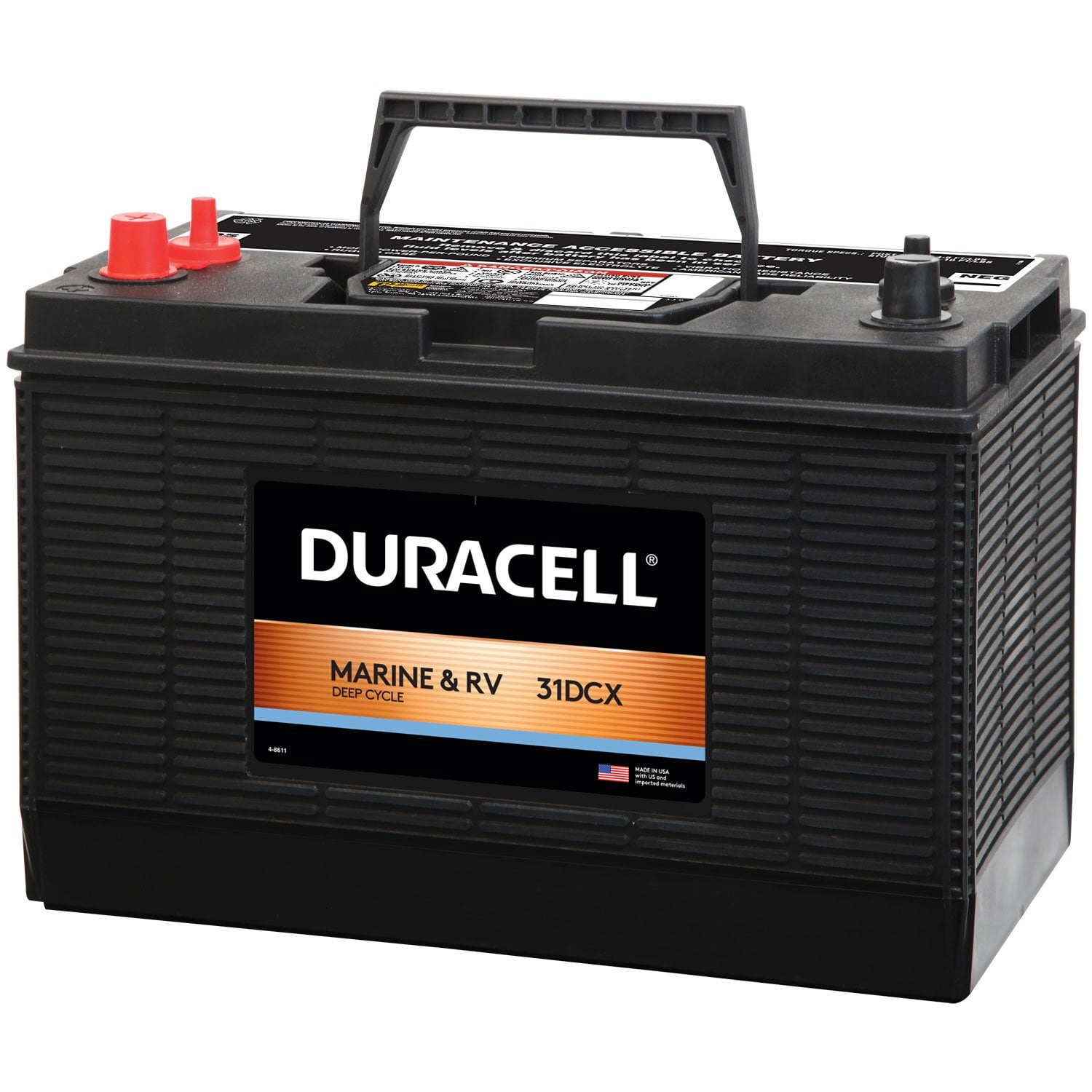
Customer reviews for Duracell Marine Deep Cycle Battery, Group Size 31 forGood choice to learn how to design a solar system.
I'm on year three with these batteries while running a part of my home electrical system. It is charged by 800 watts of solar panels. I chose these lead acid batteries for specific reasons: 1.) price; 2.) this was the first solar system that I designed, so I expected to have a learning curve; 3.) and, availability. First, let's be realistic; these are lead-acid batteries.If we were to design a lead/zinc battery that could mach the storage and cycles of lithium (or others), the cost would be astronomical. As it is, I calculated that the same storage capacity in lithium would cost five times or more as much as lead. All batteries have a life expectancy, and they all can meet a quick demise through human error. So we have a trade-off. The one-year warranty is a clue. However, the company must account for the people that strait-up ruin batteries. Most manufacturing defects should be found well before a year. And, I've used dozens of these batteries in other applications (cars, trucks, and tractors) and always get four year plus, but they do require maintenance. I have an applied science degree in controls technology. Before you build, design your system. My requirement was a system capable of running a flat screen with DVC (4 hours per day), a laptop (4 hours per day), one small refrigerator, and a microwave oven on high for 10 minutes a day. I got the appliance specs from the labels (the average refrigerator from google). The second specification was that the batteries could run the system for 48 hours from full charge down to no less than 70% with no sun. The last detail was that the maximum instantaneous draw would not exceed the 205 minute rating for the Duracell 31DCX. To match this, I then needed 31DCXs. With lead acid, battery maintenance is critical: Design your system to draw no more than 25 amps (300 Watts) per battery. Build in enough reserve. I have drawn mine below 90 percent no more than three times. A secondary problem is that lead-acid batteries a prone to sulfiding when left uncharged. Reference the following: % charge voltage 100 (full) 12.7 90 12.5 80 12.4 70 12.3 60 12.2 these can run a bit different in practice, mostly due to temperature. Again, many (most?) voltage controllers account for temperature. Some inverters shut down somewhere between 50 and 70 percent. It is best to put all batteries on line at the same time. Fully charge all batteries before hooking them up. Allow them to sit on slow charge for at least a day. Never hook up directly to a solar panel. Panels will put out way too much voltage. Use a voltage controller that has a flooded battery setting and a float setting. Note that these batteries are already filled, contrary to what some may state.Do not fill these to the top. assure the plates are covered. If you need to add to a new battery, do not use water. Use battery acid solution. Use distilled water to refill. With a controller, it is unlikely that you will need to fill often (I have never needed to add to mine). Have a de-sulfiding or battery conditioning charger on hand. Some charge controllers have this function built in. As I rarely run my system down below 90%, I can get by running a de-sulfiding protocol every 2 to 3 months. If you don't, your batteries will first begin charging and discharging quickly lowed by them not taking a full charge. They will appear dead. That being said, lithium batteries are worth considering. You still need to match them to your system. If you mess up, you've lost more money. However, they can also be more forgiving. For example, for the above system I would not run my refrigerator and microwave at the same time because it would be beyond my specifications, potentially reducing the life of the batter. Lithium is more resilient. I calculate that the cost of lead-acid starts to break even with lithium (and others) between 4 and 5 years. The lead option requires a lot more attention, but mine is a hobby.
Stay away from this battery
I bought this battery April 14th of 2019. Mfg date was February of 2019. I used the battery for my trolling motor one time that summer. The rest of the time the battery kept on a maintainer until this year. My trolling motor showed full charge but no power. Had it tested at two auto parts store and was told it had dead cells. Sams club confirmed this but of course it has a 12 month replacement warranty. The same club person told me these batteries have a lot of this issue and not to purchase another one. Don’t waste your money on this trash. There is no savings buying from Sam’s for this size battery. Just get a reputable battery from somewhere else. If you are set on buying one make sure to get yourself a load tester and check it monthly to ensure if or when it goes down you know. Mine still shows a 12v charge but is gone.
Find Something Else
Remember when the name Duracell indicated quality and long life? Not anymore. I bought this battery in august of 2019 and the date of manufacture was July of 2019. Installed it in my backup sump with a battery maintainer. Now it is the end of October 2020 and it will no longer hold a charge, not low on charge, just zero electricity. Wrote Duracell and have not heard back from them. I get it was cheap but 15 months with never being used?????
Do not buy
Wouldn’t hold charge after 14 months… it only has a one year replacement with nothing after that… so this battery is now just good for a core charge. That’s a hard pass for anything from the automotive center for me from now on.
believe the reviews, stay far away from this
11 months and only used a dozen times. Bought this as a 'house' battery for a RTT, used to power a couple of led lights, charge a couple of cellphones. now it's at 6.5 volts. not worth money.
Will not hold a charge
I bought two of these size 31 batteries to give me boondock power from my solar panels. These batteries, even new, did a terrible job of holding a charge. I have had them just over a year and their ability to hold a charge is decreasing.
Buy something different
Had these batteries just about 2 yrs. Used maybe a handful of times and they no longer charge with dead cells. My last set of batteries lasted 10yrs of a different brand. Bsr
These batteries are junk
Won’t last you’ll be lucky to get 13 months out of them there junk used mine maybe 4 times now they won’t take a charge and Duracell will not warranty them stay away
Junk
I have gone through 6 of these batteries and every time I have to fight for a replacement because they don’t last more than 13 or 14 months. Stay away but if you do buy, at 11 months exchange it for a new one.
Have had 2 of these installed on my camper going on 4 years. They have been fantastic, they stay installed all winter while the camper is plugged in with no issues. 100 watt solar panel when camping with no concerns whatsoever, always have plenty of power. the furnace blower can go all weekend without concerns of batteries getting to low even when cloudy out. recommend these, for the price they can't be beat!!